
 Nederlands
 Français
The Bambuseae are the most diverse tribe of bamboos in the grass family (Poaceae). The origin of the word Bamboo comes from the Malay word “Mambu”. Malay is the national language of Malaysia and Indonesia. In the late 16th century (1590-1600) the Dutch named it “Bamboes” after which it got its Neo-Latin name “Bambusa”. Bamboo comprises of many different species which all have unique growth rates and characteristics.
Showing 1–12 of 17 results
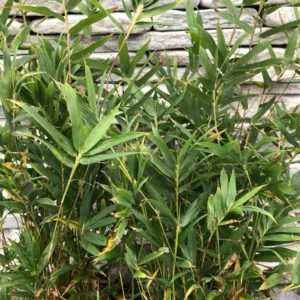
Pleioblastus Pygmaeus ‘Distichus’
Pleioblastus Pygmaeus ‘Distichus’
One of the smallest bamboos. The most noticeable characteristic of this bamboo is the very tough and erect leaf texture that very much look like little palm or fern leaves. Invasive, hardy.
Eventual size: 30-50 cm
Position:



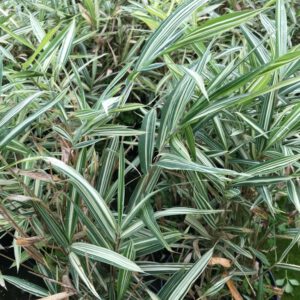
Pleioblastus fortunei ‘Variegata’
Pleioblastus fortunei ‘Variegata’
Low, tufted bamboo forming a slow-spreading colony to 1.2m high, the slender, pale green canes bearing narrow leaves to 20cm long, striped with creamy-white Invasive, hardy. Sun or part shade, moist well-drained soil.
Eventual size: 80 cm – 1 m
Position:
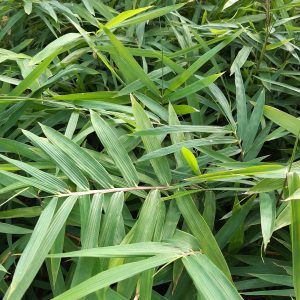
Pleioblastus pumilus
Pleioblastus pumilus
Dwarf bamboo, which is low-maintenance and evergreen, with deep green leaves and red-flushed canes. Plants are hardy and will last for many years. Invasive. Sun or semi shade. Hardy.
Eventual size: 40 – 80 cm
Position:

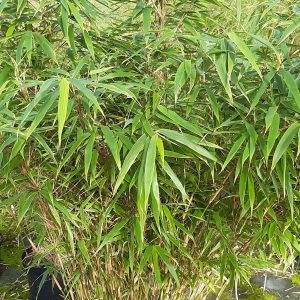
Fargesia Rufa
Fargesia Rufa
Small to medium sized, well behaved bamboo. Develops into a compact arching specimen. It has masses of small leaves on top of orange /green stems. Very hardy and tolerant of shade. Plant in good, rich soil and keep well watered until established to achieve the best possible results. Looks especially good in a container. Hardy and easy to grow. Non-invasive. Evergreen.
Eventual size: 2,5 to 3 m
Position:
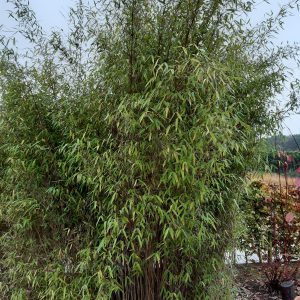
Fargesia nitida ‘Great Wall’
Fargesia nitida ‘Great Wall’
This new clone is an exciting, erect and robust growing cultivar that is close to the original form. Canes are initially upright, successive years growth make them arch elegantly under the weight of foliage – itself mid-green and generously produced on many side branches. Makes a perfect single lawn specimen or multi-planted as a screen or hedge. Best in shade in moist soil.
Non-invasive. Evergreen. Hardy.
Eventual size: 2,5 to 3 m
Position:
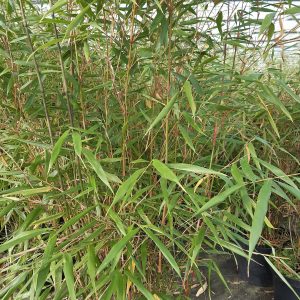
Fargesia scabrida ‘Asian Wonder’
Fargesia scabrida ‘Asian Wonder”
Beautiful clump forming bamboo with rusty-orange culm sheaths and reddish stems turning to green in the summer. Happy in most soils and situations. Non-invasive. Hardy, evergreen.
Eventual size: 3,5 to 4 m
Position:
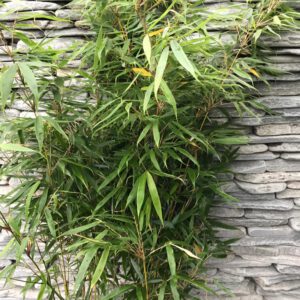
Fargesia robusta ‘Pingwu’
Fargesia robusta ‘Pingwu’
This is one of the most upright and compact Fargesias, with lovely dull green straight canes. The emerging culms are a startling green and show up well against the white culm sheaths in the spring. This bamboo will reach up to 3-5 m in height and is a well behaved clump former which will not mind growing in a shady spot. Non-invasive. Hardy, evergreen.
Eventual size: 3 to 5 m
Position:
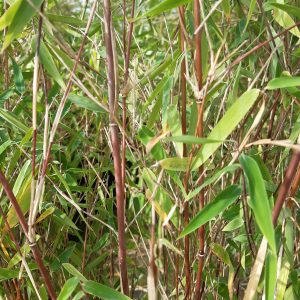
Fargesia ‘Juizhaigou’
Fargesia ‘Juizhaigou’
Clump-forming bamboo. Excellent when planted in semi-shade, where the mixture of green, purple and reddish canes are topped with dainty small dark green leaves. ‘Juizhaigou’ makes a superb specimen plant with it’s upright fountainous habit and can. Non-invasive. Hardy.
Eventual size: 2.5 to 3 m
Position:
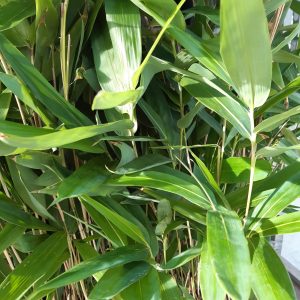
Sasa tsuboiana
Sasa tsuboiana
This Japanese bamboo has large dark green leaves and is an excellent choice for a mid-sized hedge. Does best in an area that gets some afternoon shade. Fairly fast spreading, uniform foliage. Protect from cold drying winds.
Eventual size: 1 to 1.5 m
Position:
Sasa palmata
Sasa palmata
Vigorous small bamboo forming a thicket of erect stems to 3 m high bearing dark green leaves to 40cm in length, the tips and margins turning pale brown in winter, giving a variegated. Invasive. Grow in fertile, humus-rich, moist but well-drained soil, best in partial shade. Protect from cold drying winds.
Eventual size: 3 m
Position:
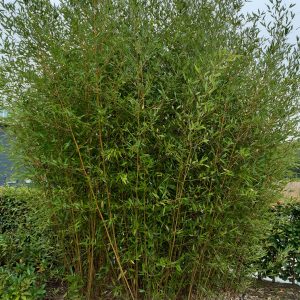
Phyllostachys Aurea
Phyllostachys Aurea
The Golden Bamboo or Fishing Pole Bamboo, has dark green canes maturing to a golden yellow. Nice and bushy and excellent as a screen. Will reach a height of between 4 and 5 metres. Easy to distinguish from other bamboos by the crowded nodes at the base of the canes. Invasive, hardy. Eventual size: 4 to 5 m
Position:
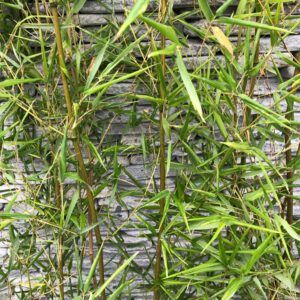
Phyllostachys Aureosulcata
Phyllostachys Aureosulcata
A hardy bamboo that has a yellow strip on a dark green culm. This is one of the hardiest bamboos. Although one out of about 10 culms have abrupt zig-zags in the lower portion, it is rigidly upright, which makes it good to plant near a walk or driveway to create an evergreen screen for privacy.
Eventual size: 6 to 8 m
Position: